|
Trust
Begins Charcoal-Burning
In
an effort to improve the sustainability of habitat
management work, the Lancashire Wildlife Trust
has begun charcoal-burning on its Warton Crag
Nature Reserve with the aid of a grant from
Arnside & Silverdale AONB Sustainable Development
Fund.
Warton
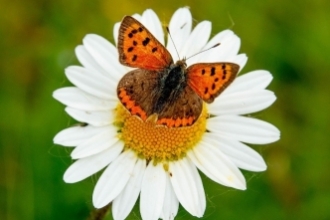
Crag is a hugely important site, supporting
populations of several butterfly species of
national conservation concern, including High
Brown Fritillary and Northern Brown Argus, Pearl-Bordered
and Small Pearl-Bordered Fritillaries. Since
early 2008, the Trust has been undertaking a
project to benefit these butterfly species on
the Crag.
Much
of the management work focuses on managing the
mix of bracken and limestone grassland, scrub
and woodland to create conditions suitable for
butterfly egg laying and caterpillars, as well
as sheltered nectaring sources for adults on
the wing.
As
part of this work, this year sees the start
of charcoal-burning as a new management activity
on the Crag. Despite a recent renaissance this
craft has disappeared from many of our wooded
landscapes, but by introducing it to this reserve
the Wildlife Trust aim to benefit butterflies
while producing a sustainable and traditional
woodland product.
In
previous winters, wood generated through scrub
management and coppicing on the Crag had simply
to be burnt in situ, but the AONB grant has
now allowed the Wildlife Trust to set up a small
ring kiln and begin charcoal-burning, using
a traditional craft to produce a sustainable
product from wood generated during the winter
work. Selling charcoal will also help to fund
further work to benefit butterflies on the Crag.
Charcoal-burning
was a part of life in our wooded landscapes
for over 4000 years, helping to shape our woodland
flora and fauna. In the past, charcoal was produced
on Warton Crag in a number of pits to provide
fuel for cooking.
Today,
much of our demand for charcoal is met by imports
from overseas. Recent increasing demand for
charcoal as a barbeque fuel has rekindled interest
in sustainable production in Britain. Charcoal
produced from native hardwood species has the
added benefit of burning hotter than imported
tropical hardwood charcoal, and taking less
time to reach required temperature.
Charcoal-burning
on Warton Crag begins with the splitting and
stacking of wood inside the kiln. Kindling is
lit inside the base and a controlled burn starts
to drive off the moisture from the wood. As
the kiln gradually reaches temperature over
the coming hours the smoke clears and the vents
and chimneys are sealed up using earth and wet
socks! This shuts off the free supply of oxygen
inside the kiln, so the wood is charred and
not burnt to ash. After cooling for a day or
so, the lid is lifted and the charcoal sorted
and bagged ready, hopefully, to be put to good
use on a warm summer’s evening!
This
work fits neatly in to the programme of current
habitat management on Warton Crag, work undertaken
by Wildlife Trust staff and volunteers from
local communities, Lancaster University students
and small herd of contented cattle!
Maintaining
the existing areas of habitat on the Crag in
favourable condition and creating additional
suitable habitats close by helps support more
viable populations of the rare butterfly species
found there, while also benefiting plant communities
and other invertebrates. The charcoal produced
and sold as part of the Trust’s work on Warton
Crag therefore helps conservation of a range
of species in North Lancashire.
Visit
our news
page for further stories.
|