

How to feed birds in your garden
By creating a wildlife-friendly garden, you can help birds to thrive outside your window!
Growing plants that give birds a natural food source is the best way to help them and here are some of our top tips:
- Plant a native tree which will provide wildlife with shelter and food
- Choose native hedging bushes and ramblers, such as hawthorn, hornbeam, blackthorn, ivy and bramble, which provide an abundance of berries and seeds for birds
- Leave seed heads over the winter – goldfinches particularly enjoy teasels!
- Welcome insects into your garden – an important food source for birds. We have lots of guides to help you to do this, from creating a wildlife pond, to leaving grass to grow long and adding a log pile.
- How to build a pond (https://www.lancswt.org.uk/actions/how-build-pond)
- Building a wildlife garden from scratch (https://www.lancswt.org.uk/actions/how-start-wildlife-garden-scratch)
- How to make a log pile (https://www.lancswt.org.uk/actions/how-make-log-shelter)
- How to create a mini meadow (https://www.lancswt.org.uk/actions/how-grow-wild-patch-or-mini-meadow)

How to safely feed birds
You can also supplement naturally available food with bird food, and watch them flock in!
Remember to keep bird feeders clean, so the birds stay healthy and disease-free, and position your feeders in a relatively open area away from predators - the birds will feel safer and visit more.
Thanks to scientific research from the RSPB, we now know more about how to reduce the risk of diseases spreading when feeding garden birds. This is especially important during summer and autumn when the risk of diseases spreading is higher.
Keep your garden birds safe
- Clean bird feeders weekly. If it’s possible, regularly move your feeders to different spots to prevent the build up of food underneath
- Feed little and often: never provide large amounts of food all at once, as this can quickly build up and begin to rot.
- Change water in bird baths and saucers daily, and clean them weekly.
- Use hanging bird feeders and not flat tables: the research shows there’s a higher risk of disease spreading on flat surfaces.
Feed seasonally
- From November to April, feed seeds and peanuts, when the benefits to birds are the highest
- Pause feeding seeds and peanuts between May and October. During this time the risk of disease is higher and there are more natural sources of food for birds available. There is also little evidence that supplementary feeding benefits birds during these months
- You can offer mealworms, fat balls or suet year-round in moderation
Flat tables can spread disease in birds, so please switch them out for hanging bird feeders
Not sure what to offer? There are five main types of bird food:
- Straight seeds – as the name suggests, these seeds aren’t mixed with anything. Straight seeds include black sunflower, nyjer, oil seed rape, peanuts, and red and white millet.
- Seed mixes – here the seeds are mixed into different blends, with the main advantage being that a greater mix of seed types attracts a greater mix of bird species.
- Husk-free seed mixes – similar to the above, the seeds in these mixes have had their husks removed, so there is much less mess to clear up and birds that can’t crack husks (such as blackbirds) can also eat the mix. Some husk-free mixes also contain other foods like mealworms and suet pellets.
- Suet (also called fat) – this food comes as blocks, balls and pellets. Lots of birds like suet and it provides a vital source of energy for them, particularly in the winter months.
- Mealworms – a brilliant food to provide in the breeding and fledgling season.
Four ways of providing food:
- Hanging seed feeders - these will attract tits, goldfinches, house sparrows, greenfinches and siskins.
- Niger/Nyjer seed feeders - designed to hold tiny nyjer seeds, these attract goldfinches, siskins and redpolls.
- Mesh peanut feeders - these allow birds to take only small chunks of peanut, rather than whole nuts that they might choke on. They will attract sparrows, starlings and tits.
- Homemade - half coconuts or a pinecone covered in fat or vegetable suet can be hung from a tree. They will attract tits, greenfinches and house sparrows. Discard after a week to help prevent the spread of disease.
Get started with our instructions below!
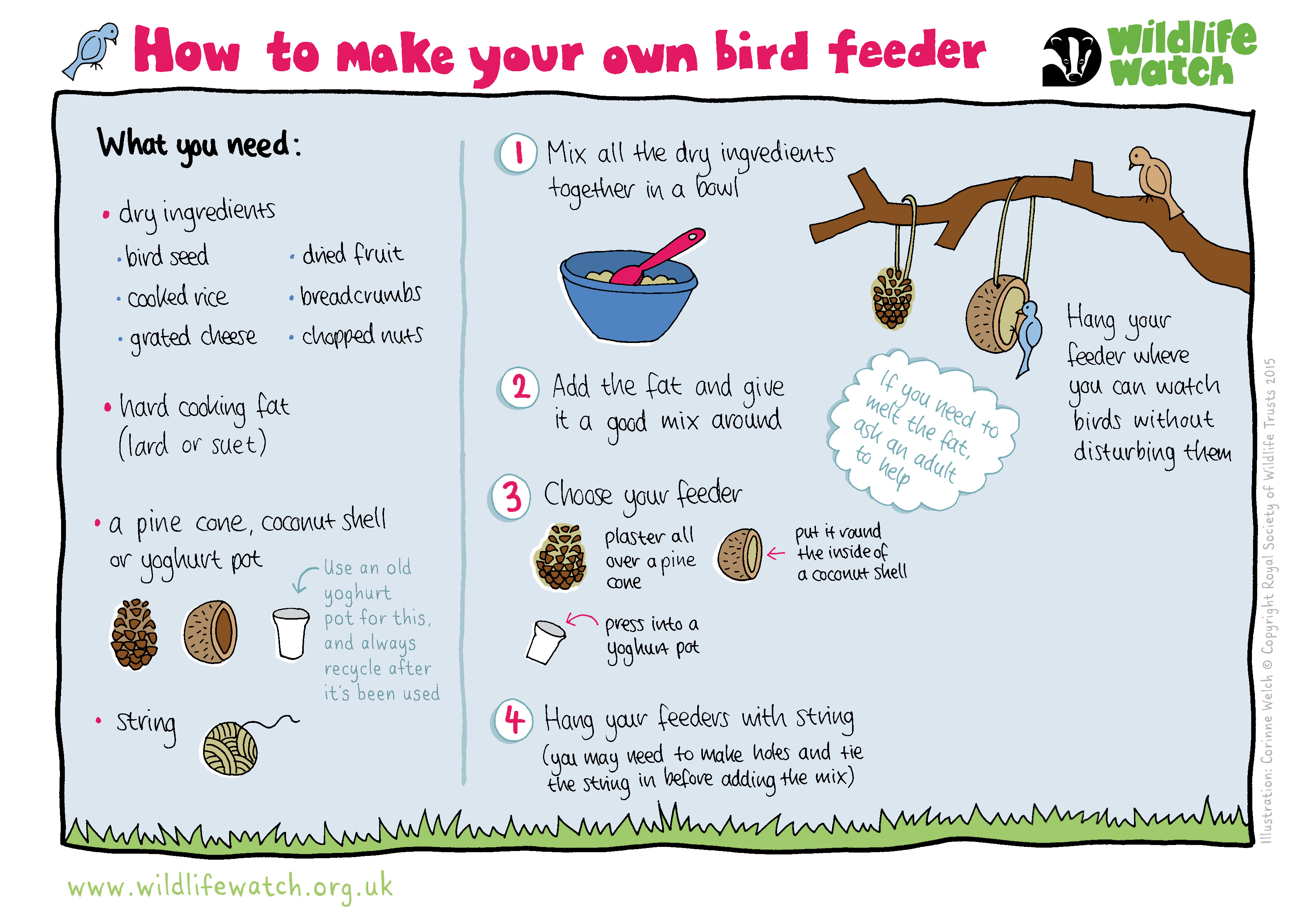
Top tips to help birds thrive in your garden
- Clean feeders and water sources weekly - this stops the spread of diseases.
- Where possible, plant natural food sources. If your garden plants have fruit, berries, hips, seeds and nuts, they'll be a larder for birds, particularly in late summer and autumn. Holly, hawthorn, ivy, rowan, honeysuckle and dogwood all provide tasty treats or attract tasty insects.
- Water is as important as food to most garden birds, and not just for drinking but bathing as well. So put out a bird bath or dish along with your feeders, change the water daily and clean the bath once a week.
- Keep feeding stations away from predators - feeders near shrubs make it easy for cats to pounce.
- Only put out what gets eaten - this way you won't attract unwanted guests.

Robin on bird feeder
My Wild Garden guide
Get your free guide full of inspiration on how to turn your garden into a haven for wildlife

Blackbird © Jon Hawkins - Surrey Hills Photography
Celebrate your wild garden
Have you been taking steps to welcome wildlife into your garden? Let us know about your wild garden, and apply for your very own My Wild Garden award!
Thanks for taking action
Thank you! Every step we take as individuals, even the smallest of actions, can make a huge impact when we all work together.
We're keen to learn more about what people in our region are doing to help wildlife. If you wouldn't mind taking a moment to tell us a bit more, this will help us build a better picture of what actions people are planning to take, and where.
By signing up to our mailing list you are opting in to receive emails about events, local wildlife, campaigns, appeals and our further work. We respect your privacy and will never sell your details, and you may change your preferences at any time. For more information about how we use your data please click here, and if you have any questions, please call 01772 324129 or email info@lancswt.org.uk.
More ways you can help wildlife

How to provide water for wildlife
All animals need water to survive. By providing a water source in your garden, you can invite in a whole menagerie!

How to start a wildlife garden from scratch
Use the blank canvas of your garden to make a home for wildlife.

How to build a bird box
With natural nesting sites in decline, adding a nestbox to your garden can make all the difference to your local birds.