Species spotlight: Tawny owls and their contemporary evolution

Species spotlight: Tawny owls and their contemporary evolution

Amy Scarr from our Youth Council tells us about the contemporary evolution of tawny owls, the UK's most common owl, and the threats they currently face.
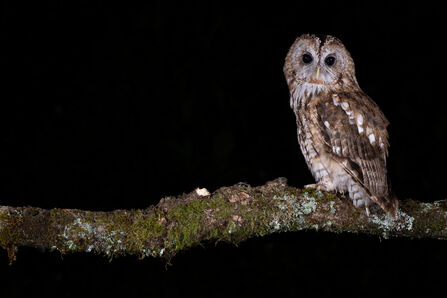
Tawny Owl Credit Jon Hawkins Surrey Hills Photography

Tawny Owl Credit Jon Hawkins Surrey Hills Photography 

The UK famously has many owl species, yet our most common resident is facing a hidden battle. 

Climate change has already wreaked havoc across the globe, but it is also having a very tangible impact on our own wildlife. Without intervention, we risk losing much of our beloved native flora and fauna. Strix aluco, otherwise known as the tawny owl, is being profoundly affected by climate change. 

Astonishingly, they have nonetheless maintained their “stable” status on the IUCN red list. See this is actually a tale about how they have evolved to ‘counter’ the consequences of climate change! Tawny owls have adapted their own morphology to withstand this crisis, continuing to thrive in spite of it.

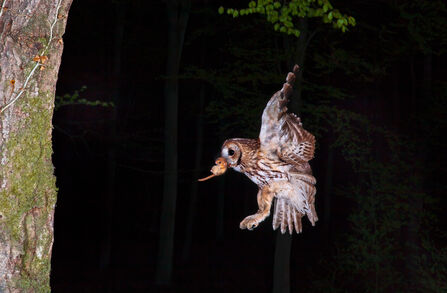
Tawny Owl Credit Bob Coyle

Tawny Owl Credit Bob Coyle

Tawny owls are a polymorphic species which means that they have various appearances. This allows them to succeed in different environments and provides a strong selective advantage. 

Plumage colour is determined by genetics and is thus, a highly heritable trait which doesn’t vary over the owl’s lifetime or seasonally. It is created by pheomelanin pigments deposited in their feathers - the greater the pigment deposited, the darker the plumage colour created. This produces two major tawny owl morphs, characterised by either grey or rufous plumage. Each morph provides the owl with an assortment of physiological advantages, specific to certain environmental conditions. The potential selective advantages conveyed by each morph are as follows: crypsis, parasite immunity, ultraviolet radiation protection, reproduction effort, offspring fitness, hunting generality and plumage insulation. These varying assets allows both colour morphs to remain prevalent within the tawny owl species as a whole. The proportion of these morphs within a population does, however, differ depending on the local environmental conditions.

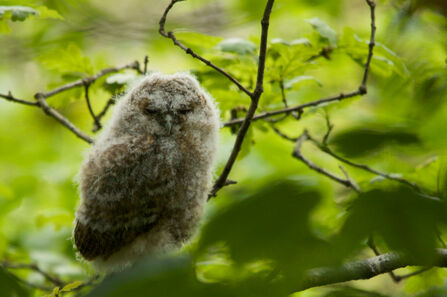
Tawny Owl Credit Steve Davis

Tawny Owl Credit Steve Davis

Research suggests that the environmental factor most significant in influencing tawny owl morph proportion is the colour tone of its habitat. This is created by the synergistic effect of other environmental conditions, such as mean ambient temperature, annual weather conditions and habitat vegetation. These other environmental conditions may also impose selective pressures on the tawny owl morphs. For example: in cool, dry years, rufous tawny owls will experience a greater mortality than grey tawny owls and vice versa. The tawny owl population would, therefore, likely shift towards a greater proportion of grey tawny owls following cool, dry years. This is a clear incident of natural selection as only the surviving morphs were able to pass on their genes. Consequently, this ensures that the remaining owls likely possess the best morph for the environment.

Tawny Owl Credit Margaret Holland

Tawny Owl Credit Margaret Holland

The crypsis of each morph is dependent primarily on the colour tone of its habitat. The weather during winter can greatly change the colour tone of an owl’s habitat, particularly if snow occurs. Grey tawny owls experience a greater crypsis than rufous tawny owls during snowy winters as the lower contrast provides them with camouflage. Additionally, they are less distinctive against evergreen spruce and pine trees which are often present during winter. Although prey to the tawny owl, passerines will form a large group to harass the predator, attempting to drive it away from their own territory and increase their own survival rate. This forces the owl to move and exert unnecessary energy which may be incredibly detrimental during periods of food scarcity.

Tawny Owl Credit Margaret Holland

Tawny Owl Credit Margaret Holland

Furthermore, mobbing may alert nearby predators, such as goshawks, to the location of the tawny owl. Crypsis fortunately causes an increase in detection time, allowing tawny owls to better escape potential mobbing or predators.  Contrastingly to grey morphs, brown plumage confers crypsis in winters without snow. It is more analogous to the coniferous vegetation or urban structures in the background. It also likely improves crypsis in rainy weather as they are harder to spot in the reduced light levels associated with cloudy weather. A comparable effect is observed in humid conditions as red light is scattered by water vapour, reducing the visibility of rufous plumage. This is accentuated even further in urban areas due to the presence of dust particles.

Tawny Owl Credit Tom Hibbert

Tawny Owl Credit Tom Hibbert

Unfortunately, climate change is imposing numerous stresses on tawny owl populations, the largest of those being milder winters and increasingly irregular dynamics of their primary food source, voles. These milder winters are reducing the snow cover and consequently, raising the mortality of grey tawny owls. Instead of the species becoming threatened however, tawny owls are undergoing contemporary evolution. The overall composition of this species is shifting to a greater proportion of rufous plumage. This rufous plumage grants them with crypsis, alongside protection against ultraviolet radiation, better suited for the current environmental conditions. Furthermore, rufous morphs are often more generalist hunters, reducing the species’ reliance on voles as a food source. Contemporary evolution is vital for survival in rising temperatures and has been observed in progressively more species. It is a crucial demonstration of how life can adapt in the wake of a changing Earth… yet, we must still take action to protect our most vulnerable species from climate change!

If you would like to support other owls in our region, check out our online shop where you can adopt a barn owl for yourself, or as a gift for a loved one.