
Geranium robertianum, also known as Herb-robert, is simply a wonderful countryside flower. It's a delicate gem that can be found searching its way along fences, walls, mossy rocks, grass verges, within garden borders, and the nooks and crannies of many a garden environment; even stony seashores on base-rich soils. This delightful wildflower, a type of cranesbill belonging to the family Geraniaceae, is native to Europe, and is common and widespread through Britain and Ireland.
Species spotlight: Herb-robert, a delicate but tenacious wildflower

In this guest blog, Horticulturist Kevin Line teaches us about herb-robert (geranium robertanium), a native wildflower with plenty of benefits to wildlife as well as a fascinating history in folklore and medicine.

Kevin Line
When to see herb-robert
The normal flowering period is from April-October in a good long favourable season, and in sheltered warmer locations, it can hang on until November. Geranium robertianum is monocarpic, meaning it flowers once and then dies. The self-seeding process keeps it re-generating each year; I describe it as beautifully tenacious!
How to identify herb-robert
Herb-robert grows up to 30cm, and the five-petalled pink flowers are 8-15 mm wide, held upon reddish coloured stems. The foliage is deeply divided, and has a very attractive leaf formation, which comes into its own during autumn as it transforms to an eye-catching red shade of colour.
All aside my personal gardening experiences with Herb-robert it makes for even more interesting gardening around this little and truly amazing wildflower!
I've spotted it flourishing at the base of a Versailles-style wooden planter in the garden entrance of where I work, pushing out from a residue of soil and gathering of autumn leaf fall within a tarmac base! Incredible. I hadn't the heart to remove it as a weed, so it remained intact and happy.
I've always been aware of the presence of this quite inconspicuous and yet incredible wildflower which lends itself to being known within many garden spaces, spilling in from the countryside. I think that's what I find truly embracing and engaging, the concept of hedgerows to garden, linking the two.
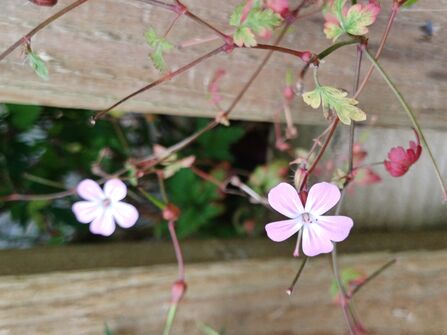
Kevin Line
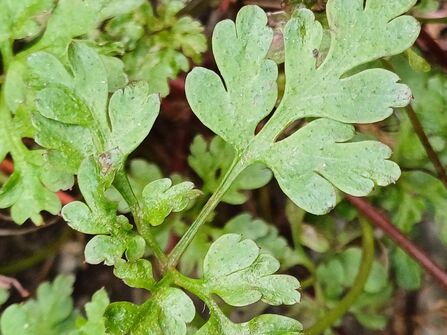
Kevin Line
The life cycle of herb-robert
Delving deeper into this small-flowered cranesbill, it has the potential to fulfil its reproductive cycle all year round! Seeds that are produced in mid-spring to autumn are able to form a leaf rosette in the soil and start flowering from the following spring. Also, seeds that overwinter may lie dormant until spring and produce plants later in the summer.
The seeds are ejected from reddish capsules, and new seedlings will appear throughout the growing season and into spring.
From the gardener’s perspective, it's wonderful we can witness the impressive delicate foliage of herb-robert as it pushes out from cracks and crevices in walls, and at the base line of garden paths and hedgerows! This adds to the joy and pleasure of gardening, accepting the wildness, and knowing that it's there.
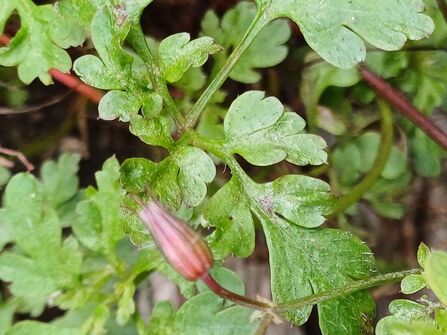
Kevin Line
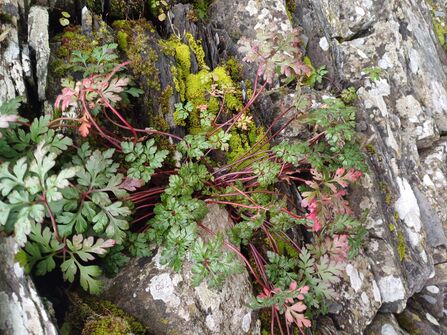
Kevin Line
What are the benefits of herb-robert for wildlife?
This little gem is a valuable UK native wildflower species that is great for biodiversity. It is a food plant for moth species including the barred carpet moth, and the pink star-shaped flowers are a nectar support for bees, butterflies, and hoverflies.
As mentioned, Geranium robertianum also functions as a natural pest deterrent in our gardens due to its scent which is unpleasant, and offers smaller forms of wildlife habitats in shady, rocky areas. I recall spotting a beautiful toad in late autumn one year in a rocky garden area beneath the plant mass foliage cover of herb-robert; insect life abounds too throughout the year in mass areas of the flower.
In shady wooded areas this little flower provides plenty of cover and food for insects, particularly thriving in nutrient to poor soil or disturbed habitats. It's interesting to note that this lovely delicate wildflower is not favoured by deer or rabbits.
Traditional uses of herb-robert
Herb-robert has a long history of traditional uses in folk medicine, including treatments for stomach upset, toothache, nosebleeds, soothing problems with the liver and gallbladder, and to heal wounds. I've no first-hand experience with this, but it's interesting to note. The crushed leaves are also said to act as an insect repellent!
Some studies have shown antioxidant, antimicrobial, anti-inflammatory, anti-hyperglycaemia, and cytotoxic properties of this wildflower. Research informs me that this is due to the high levels of phenolic compounds in the plant which contains tannins.
There’s a fascinating history in folklore surrounding herb-robert, too, and its many names including red robin, bloodwort, Stinking Bob, Death come quickly, and more!
Look out for it in your gardens, and if you don't have your own green space, get out there and enjoy looking for it on your walks, as you're likely to spot it in a diverse set of environments.

Kevin Line
About the author
Kevin Line is Head Gardener / Horticulturist at the Lakeside Hotel Garden, Cumbria.
Kevin is a passionate supporter of the Wildlife Trusts, member of the Lancashire Wildlife Trust, and the Professional Gardeners' Guild.


Bee on cow parsley, Sunnybank NR, Sheffield City Centre - Paul Hobson
Celebrate your wild garden
Let us know what you've been doing to help pollinators and other wildlife in your garden, and apply for your own My Wild Garden award!