Latest wildlife sightings - December 2025

Latest wildlife sightings - December 2025

The chaos of December is the perfect excuse to get out on one of nature reserves to find some calm and solace in nature. Despite busy calendars, our visitors have shared some striking photographs of their wildlife moments with us from their visits to our reserves this month.
Female stonechat bird perched on a branch at Lunt Meadows Credit Steve Brayne Photography

Stonechat bird at Lunt Meadows Credit Steve Brayne Photography

Lunt Meadows

Stonechat

Regular visitor and passionate wildlife photographer Steve Brayne headed out to our Lunt Meadows reserve before Christmas in the hopes of spotting our famous short-eared owl. Our beloved 'shortie' was nowhere to be seen, but he was rewarded with a beautiful shot of a female stonechat perched on a branch displaying it's distinctive colours.

The stonechat is named for its call, which sounds just like two small stones being hit together.

Short eared owl in flight at Lunt Meadows Credit Kevin Hall

Short eared owl at Lunt Meadows Credit Kevin Hall

Short-eared owl

Our short-eared owl made an appearance for Kevin Hall on his visit to Lunt Meadows, and he captured some brilliant photos of its hunt for Christmas dinner.

Short-eared owls hunt happily in the daytime, and are more commonly seen in the winter months. They feast on voles and other small birds, and nest on the ground in scraped out hollows that they make from grass and downy feathers. Lunt meadows is the perfect habitat for them. 

Female sparrowhawk in flight against a blue sky at Lunt Meadows Credit Kevin Hall

Female sparrowhawk at Lunt Meadows Credit Kevin Hall

Sparrowhawk

Sparrowhawks is one of the UK's smallest bird of prey. This one is a female and is larger than the male, with browner plumage above, and grey bars below. They both have reddish cheeks.

Sparrowhawks are classified in the UK as Amber under the Birds of Conservation Concern 5: the Red List for Birds (2021), making places like Lunt Meadows a valuable habitat for them to thrive.

Learn more about our region's birds of prey, and how to identify them from our blog

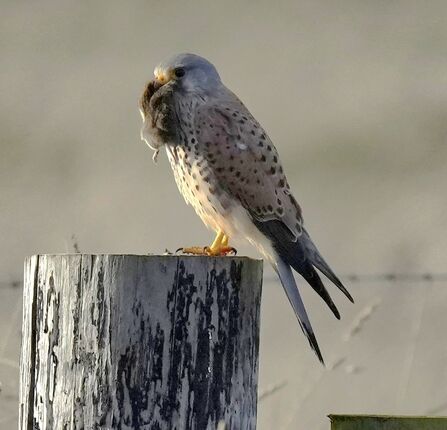
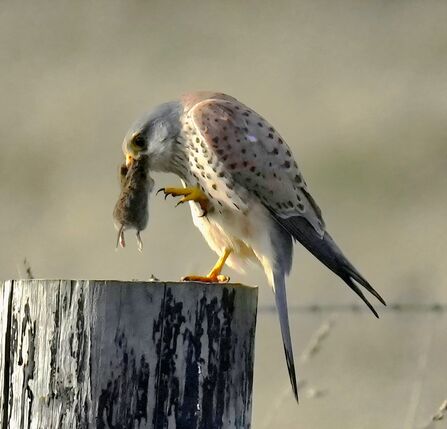
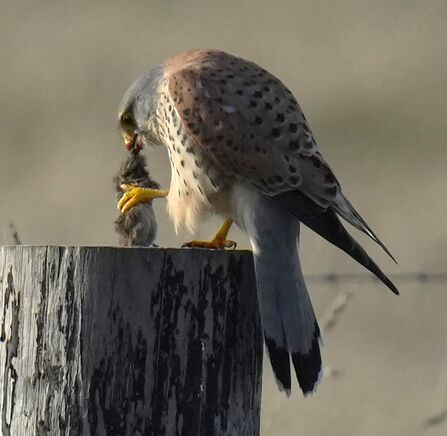
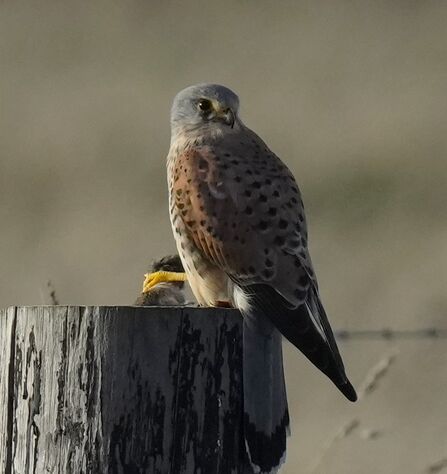
Male kestrel with vole for dinner at Lunt Credit Kevin Hall

Male kestrel with vole for dinner at Lunt Credit Kevin Hall

Kestrel 

We loved this series of photographs, taken by Kevin Hall at Lunt Meadows this December. He has expertly captured the moment a kestrel caught a vole for its Christmas dinner. The kestrel seems to look around to check that no other bird will fight him for his catch before tucking in! 

Kestrels prefer open habitats to hunt in, like farmlands and heathlands, which is why you often see them hovering above their prey on open land near motorways. The kestrel has the ability to keep its head still while it does this, even in strong winds, helping it to pinpoint its prey by sight. This behaviour gave kestrels their old country name 'the windhover'.

Roe deer at Brockholes Credit Shaun Maudsley

Roe deer at Brockholes Credit Shaun Maudsley

Brockholes

Roe deer

Even if it's quiet on the water at Brockholes in the cold weather, and small mammals are huddled up in hibernation, you can always count on an appearance from our resident roe deer! On his first visit to the reserve, Shaun was delighted to capture this photo of a deer among the apples. He noted that the deer 'wasn't the least bit bothered by us 20ft away as we rounded the bend.'

Find out more fascinating facts about the roe deer, their habitats and behaviours here

Goldcrest at Brockholes Credit Steve Brayne Photography

Goldcrest at Brockholes Credit Steve Brayne Photography

Goldcrest

Steve Brayne had a Christmas Eve walk around Brockholes Nature Reserve in Preston and managed to get a shot of one of his favourite little birds, a goldcrest.

This photo shows off the gorgeous colours of this tiny bird, which is one of the smallest birds in Europe. You can clearly see it's golden crown, which lends the bird it's name. Its Latin name, Regulus regulus, also refers to its crown and means 'little king' or 'prince'.

Blue tit on a branch in the winter sunshine at Mere Sands Wood Credit Beckie Delaney

Blue tit at Mere Sands Wood Credit Beckie Delaney

Mere Sands Wood

Blue tit

Mere Sands Wood is home to a variety of fascinating birds, and due to it's familiarity in gardens and towns, we often overlook the bright little blue tit.

Beckie Delaney took this lovely photo of a blue tit parading it's colours in the winter sunlight this month. 

In winter, blue tits form flocks with other tits, roaming the countryside and visiting gardens in groups. They are resilient birds who have adapted to urban areas and are as happy to visit bird feeders as much as they actively hunt insects and spiders in woodlands, farmlands and wetlands.

Woodpecker at Mere Sands Wood Credit Mark Lazenby

Woodpecker at Mere Sands Wood Credit Mark Lazenby

Great spotted woodpecker

Mark Lazenby was lucky enough to spot (and probably hear!) a great spotted woodpecker on his visit to Mere Sands Wood in December. In his striking black and white jacket, this one looks to be a male as you can just about see the red patch at the back of it's head.

Great spotted woodpeckers eat insects and larvae, probing tree trunks with their extremely sticky tongues to extract them from their nests. In winter, they switch to eating berries and nuts, and will visit peanut feeders in gardens, so make sure you provide these for hungry woodpeckers in the winter!

Snails huddling together against the cold at Heysham

Snails huddling together against the cold at Heysham

Heysham

Garden snails

One of our visitors to Heysham reserve shared this photo of snails happily huddling together on the Wave Reflection Wall in Morecambe.

This behaviour in snails is common during cold snaps, and just goes to show that we all need to keep warm in the winter weather! The collective noun for snails gathering like this is an 'escargatoire', derived from the French word for snail. They are also known as a 'walk' or 'trail' of snails!

Cormorant swallowing a bass whole in the water at Heysham Credit Janet Packham

Cormorant swallowing a bass at Heysham Credit Janet Packham

Cormorant

Janet Packham captured the impressive moment when two cormorants battled it out for a tasty bass! You can see the winner of dinner swallowing the huge fish whole.

She called it the 'battle for the bass' and noted that 'the biggest mouth won'!

These large black waterbirds are usually seen perched on rocks or banks with their great wings spread out to dry themselves, as their feathers are not waterproof. 

Have you seen some wonderful wildlife at one of reserves recently? Share with us on FacebookX or Instagram!

Don't have social media? You can send your snaps to us via this form

Alternatively, you could enter our monthly photography competition!